
Reviewed · DOLPHIN WATCHING
Auckland: Whale and Dolphin Watching Half-Day Eco Cruise
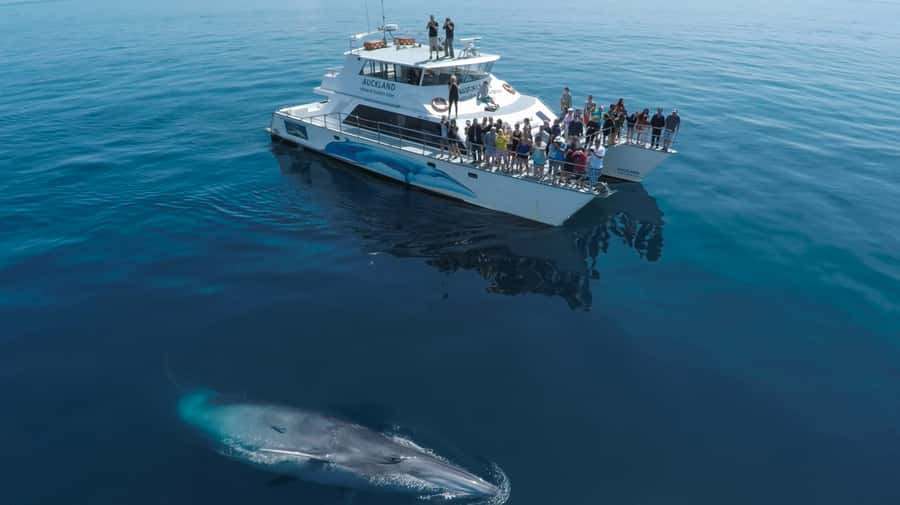
The best part of this Auckland cruise is the chance to see wild dolphins close to the boat, with the city, Rangitoto Island, and open Hauraki Gulf as your backdrop. The crew also uses the trip for marine research, so you get more than a sightseeing ride. You may see plankton sampling, animal tracking, or explanations of how the team reads seabird activity to find feeding areas.
I like the small enough boat for good viewing and the strong conservation purpose, with $1 from each ticket supporting the Hauraki Gulf Guardians fund. I also like the sensible no-sighting promise: if no marine mammals appear, you receive a voucher for another cruise. The main caution is simple: wildlife is wild, and whales are not guaranteed. You can have a fine day with dolphins, birds, and fine views and still miss the largest animals.
Key points before you book
- Wildlife is never guaranteed: Dolphins appear often, but whales and orcas are less predictable.
- The trip lasts 4.5 hours: Allow extra time around your Auckland plans, especially if sea conditions slow the return.
- The Dolphin Explorer is a 65-foot catamaran: You get several viewing spots without being on a huge vessel.
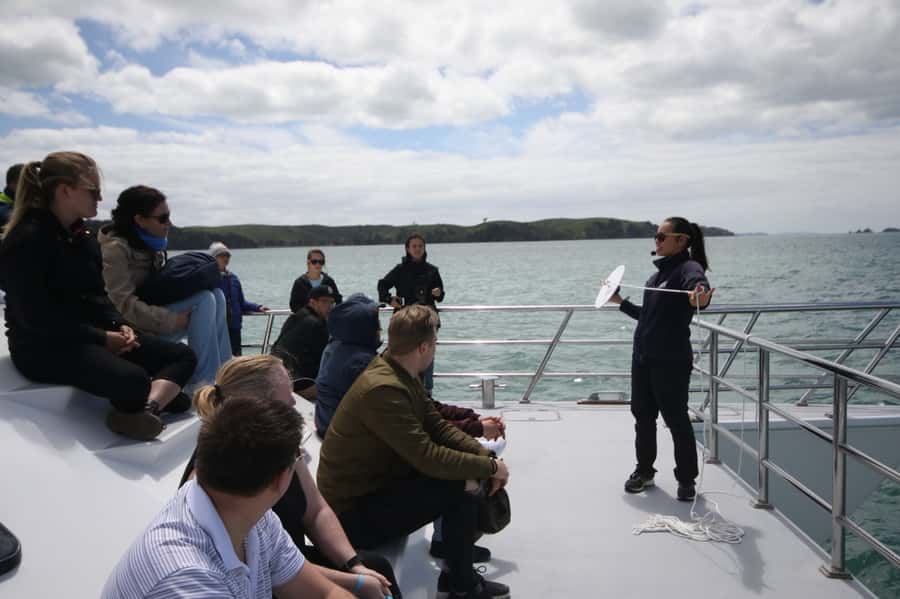
- Marine science is part of the outing: The crew may collect samples and explain research into plankton and marine mammals.
- You can cruise again after a blank day: A free second cruise is offered when no marine mammals are seen.
- Prepare for wind and spray: Bring warm layers, a showerproof jacket, sun protection, and motion-sickness medicine.
Leaving Auckland from the Eastern Viaduct
The cruise begins at Berth 9 in the Eastern Viaduct Marina, opposite the Maritime Museum. That location is handy if you are staying near the waterfront, but do not cut it close. Check in at the top of the boarding ramp 30 minutes before departure, and check-in closes 15 minutes before sailing.
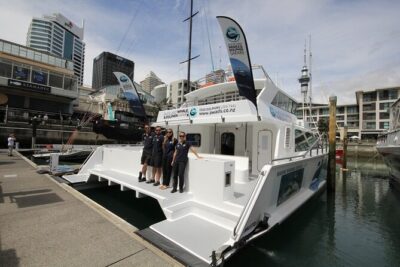
The boat is the 65-foot luxury catamaran Dolphin Explorer. Its size gives you a useful middle ground. It is substantial enough to feel steady and comfortable, yet not so large that you are one face in a crowd. Several seating choices are available, and the open edges make it easier to get a view when wildlife appears.
The vessel is not wheelchair accessible because of stairs and narrow doorways. Children under five can come along only with close supervision, and unaccompanied minors are not allowed. The trip is also not suitable for people who are heavily pregnant.
Food is not included, though you can buy a small selection of snacks, hot food, and drinks on board. Beer and wine are available as well. I would eat something before boarding if you are prone to seasickness, since the boat may spend several hours in open water.
More dolphin trips out of Auckland:
- Auckland Dolphin and Whale Watching Eco-Safari Cruise
★ 4.5 · 1,790 reviews - Auckland: Tikapa Moana Whales, Dolphins and Islands Cruise
★ 3.9 · 292 reviews - Auckland: Tikapa Moana Dolphin, Whale and Island Cruise
★ 4.0 · 17 reviews
North Head, Devonport, and Rangitoto from the water
The first part of the outing gives you a quick change of view from city streets to the gulf. The boat passes North Head and Devonport, then heads toward Rangitoto Island. These early views help you understand Auckland’s setting: a city built around a large natural harbor, with volcanic islands and open sea close at hand.
Rangitoto is especially photogenic from the water. The island’s familiar volcanic outline makes a strong backdrop for the first part of the cruise, while Auckland’s waterfront recedes behind you. If you have already seen the city from land, this angle gives you a useful sense of its scale and geography.
This is also a good time to settle into the boat and find your preferred viewing position. Wildlife sightings can happen on either side, so avoid treating one rail as your permanent post. The crew will direct attention when something appears, but you should keep scanning the water and sky.
Searching for dolphins, whales, and orcas
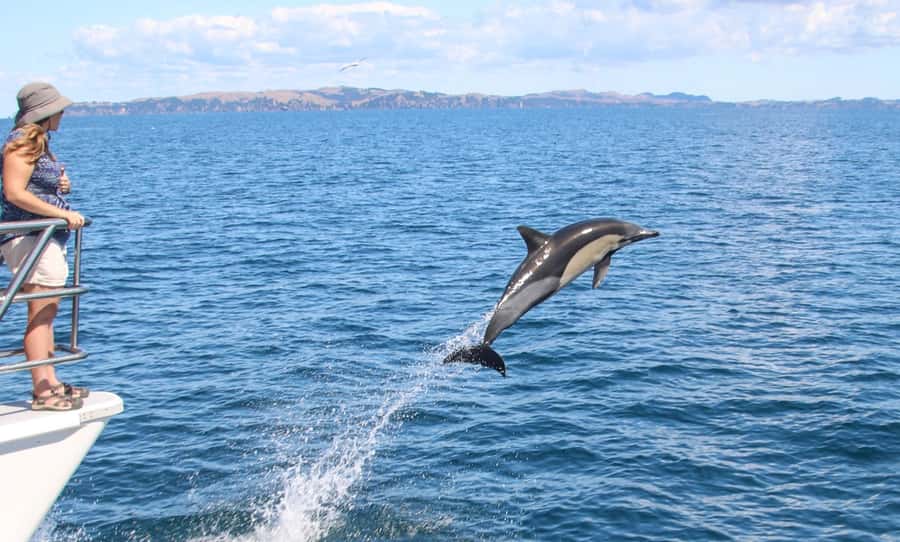
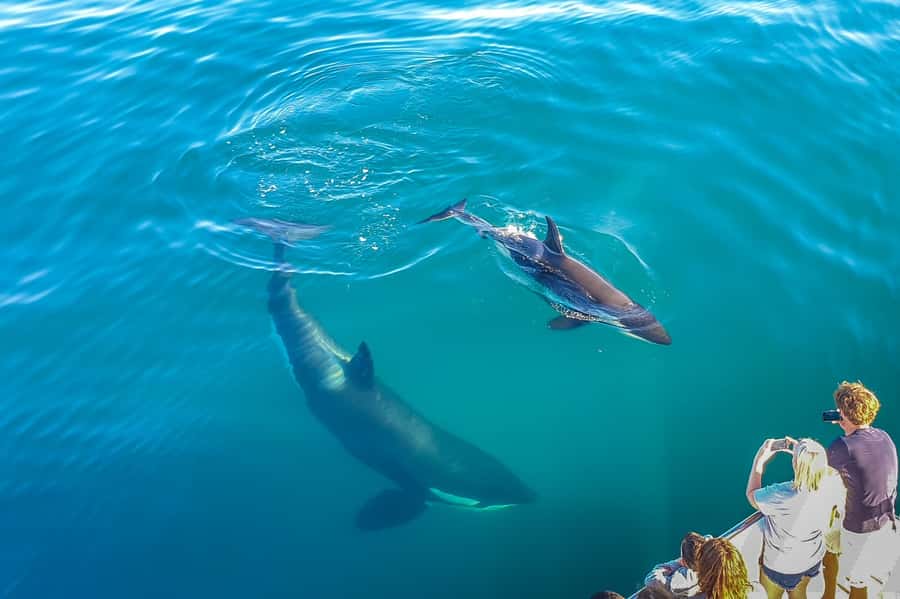
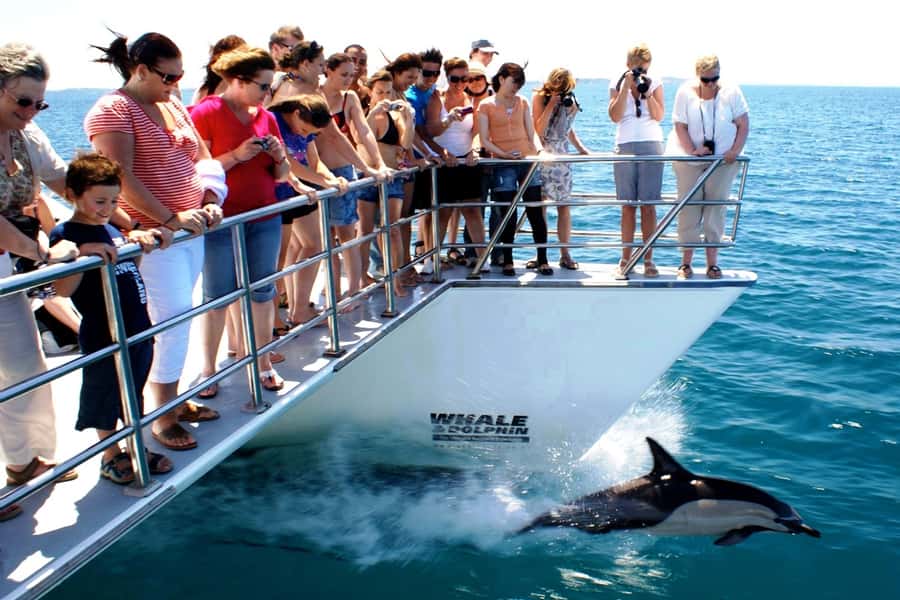
The core of the cruise takes place in the Hauraki Gulf Marine Park. The crew looks for bottlenose and common dolphins, whales, orcas, and marine birds. Sightings can be wonderfully close. Dolphins have been seen swimming beside and underneath the boat, sometimes with young animals in the pod.
That close viewing is one of the strongest reasons to choose this trip. The Dolphin Explorer can approach marine mammals more closely than many whale-watching operations, while still keeping the animals’ welfare in mind. The crew allows time for observation rather than making a quick pass and racing away.
The word safari is useful here. The crew does not know exactly what the day will bring, and the search can take time. Some outings produce large dolphin pods, several whales, sharks, penguins, and seabirds. Others produce birds and fine scenery but no mammals at all.
Recent sightings have included Bryde’s whales, blue sharks, hammerhead sharks, common dolphins, little blue penguins, gannets, and shearwaters. One particularly strong outing included more than 100 dolphins and a pair of whales. Another included a large dolphin pod, a blue shark, and two Bryde’s whales.
Still, you should not book this expecting a guaranteed whale encounter. Several excellent outings found dolphins but no whales. One trip saw no marine mammals at all, yet the crew continued with explanations of marine science, geography, birds, and the surrounding waters.
Why the crew makes a difference
The crew is central to the experience. Guides and marine scientists provide live English commentary, identify animals, explain behavior, and help you understand what you are seeing. Names noted during recent trips include Emily, Sanaa, John, Joseph, Toni, George, Jess, Jo, and Brittany.
You may not have every one of these people on your sailing, but the pattern is clear: the crew combines boat operation, wildlife spotting, and marine research. John has been singled out for keeping the mood light while still explaining sightings clearly. Emily, Sanaa, and other guides have been praised for their energy and care for the ocean.
I particularly like the research angle because it gives the trip a purpose beyond collecting photographs. The crew may stop to take a plankton sample or explain how scientists follow seabird feeding activity, sometimes called a workup, to locate larger marine animals. You are not simply being driven around until something appears. You are being shown how the search works.
The research can also make a quiet stretch of water more interesting. Even when there are no whales beside the boat, you learn about small organisms, food chains, marine behavior, and the way scientists monitor the gulf. That matters on a nature trip, since empty water is part of the natural setting rather than a sign that the outing has failed.
Same drive out of the city, a very different day:
- Waiheke Island: Ferry & Hop-On Hop-Off Explorer Bus Tickets
★ 4.6 · 3,311 reviews - Hobbiton & Waitomo Caves Guided Day Trip from Auckland incl lunch
★ 5.0 · 2,677 reviews - From Auckland: Hobbiton & Waitomo Caves Day Trip with Lunch
★ 4.9 · 2,505 reviews - Auckland: Hobbiton Movie Set Day Trip with Festive Lunch
★ 4.8 · 1,431 reviews
What you might see besides whales
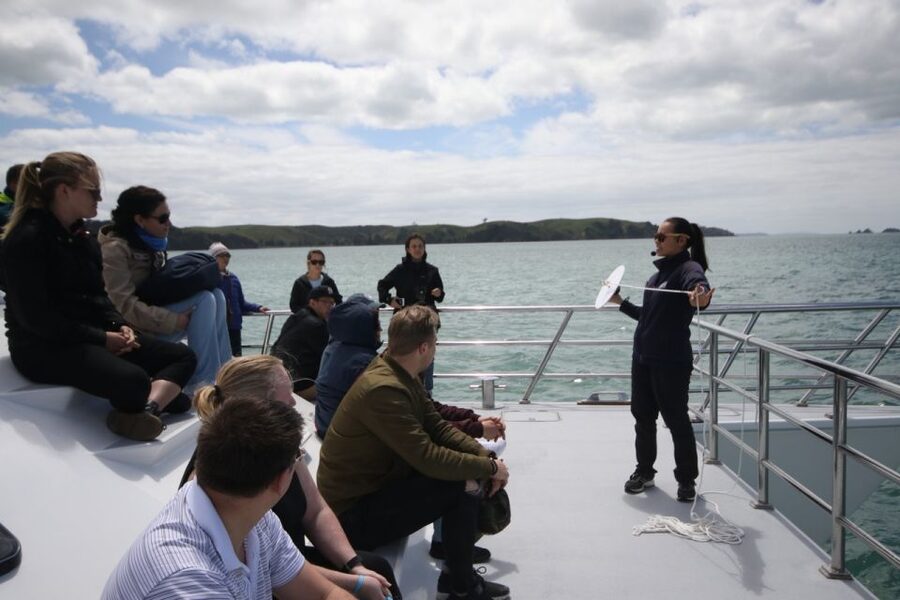
Dolphins are the most dependable reason to book this cruise. Several outings have found multiple pods, and some groups watched them for around 30 minutes. Seeing babies among the pod adds a special touch, particularly when the animals move close to the catamaran.
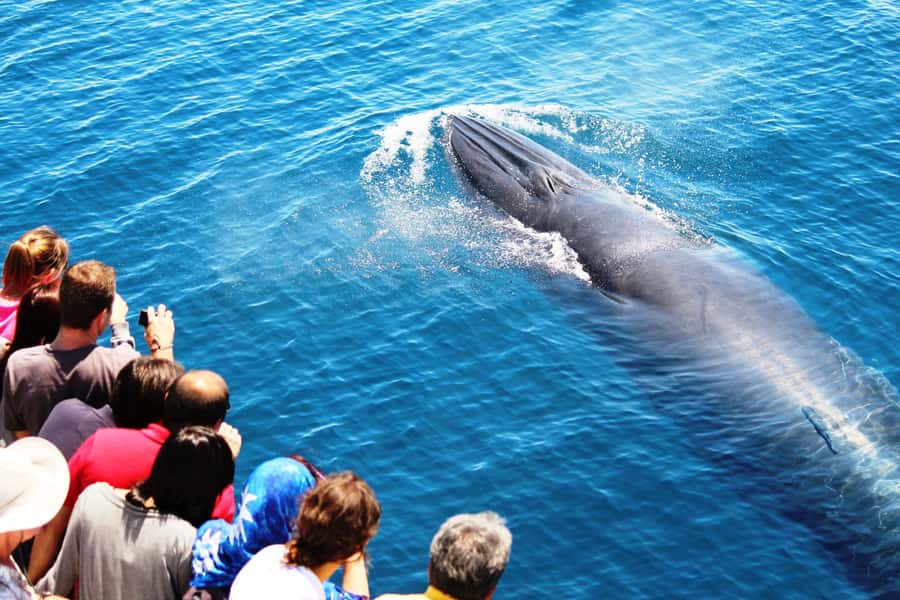
Whales are less certain but can be spectacular. Bryde’s whales are among the species seen, sometimes at a distance and sometimes close enough to create an exciting change in the pace of the trip. You may see one whale, several whales, or none.
Birdlife adds another layer. Australasian gannets can be seen plunging into the water after fish, while shearwaters and other seabirds may gather around feeding areas. Little blue penguins have also appeared during cruises. These sightings are easy to overlook if you focus only on large animals, so listen when the guide shifts attention to the sky or water surface.
Sharks have been spotted too, including blue sharks and a hammerhead. They are not promised sightings, but they show how varied the gulf can be. Bring binoculars if you have them, especially for distant whales and birds. A camera with a fast shutter speed is useful for dolphins and gannets, but keep watching with your own eyes. Wildlife often appears for only a few seconds.
The real value of the $130 price
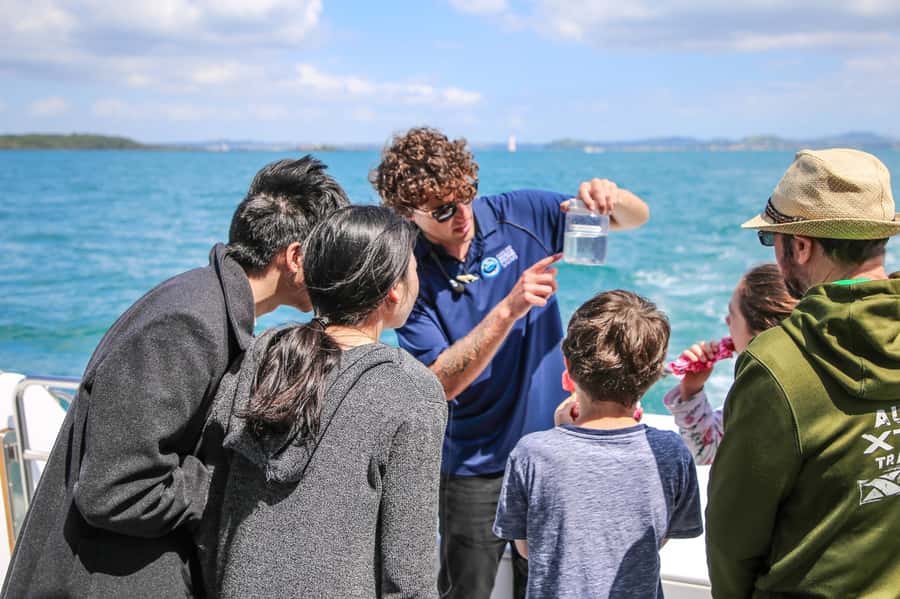
At $130 per person, this is not a cheap harbor ride. You are paying for 270 minutes on the water, a specialist crew, a relatively comfortable catamaran, wildlife searching, and access to a marine park without leaving Auckland.
The value improves if you care about the conservation work. One dollar from every ticket goes to the Hauraki Gulf Guardians fund, and the boat also supports marine research. You can see staff carrying out parts of that work during the trip, including sampling and discussion of plankton and animal behavior.
The price is easier to justify on a good wildlife day, when you see dolphins, whales, birds, and perhaps sharks. It is harder to judge if you spend four and a half hours without marine mammals, even though the free second cruise helps. If you are in Auckland for several days, that repeat option has real value. If you leave the city immediately, it may be difficult to use.
The outing also compares well with an aquarium visit if your priority is seeing animals in the wild. You have less certainty, but the behavior is genuine and the conservation message is much stronger. If you need guaranteed animal viewing, choose a land-based attraction instead.
Weather, comfort, and seasickness
The gulf can be calm as a millpond, but conditions change. Some outings have gone ahead after a large-swell warning, while others have offered a refund or rebooking when a storm warning made the trip unsuitable. The provider can cancel for wind, weather, or sea conditions.
Wear more than you think you need. A warm top and showerproof jacket are essential, even on a sunny Auckland morning. Add a sun hat and sunscreen because the glare off the water can be strong. Rain has appeared late in otherwise pleasant trips, and wind can make the ride feel cooler than it does on the dock.
If you get seasick, take your medication before departure, as advised by the operator. Do not wait until the boat is moving. Keep personal medication with you, and bring water if you prefer to have your own supply.
The catamaran offers seating, but you will likely want to move around when animals are spotted. Wear shoes and clothing that let you stand comfortably. The crew works to keep people safe and comfortable, but open-water viewing involves movement, wind, and spray.
Who will enjoy this Auckland cruise most
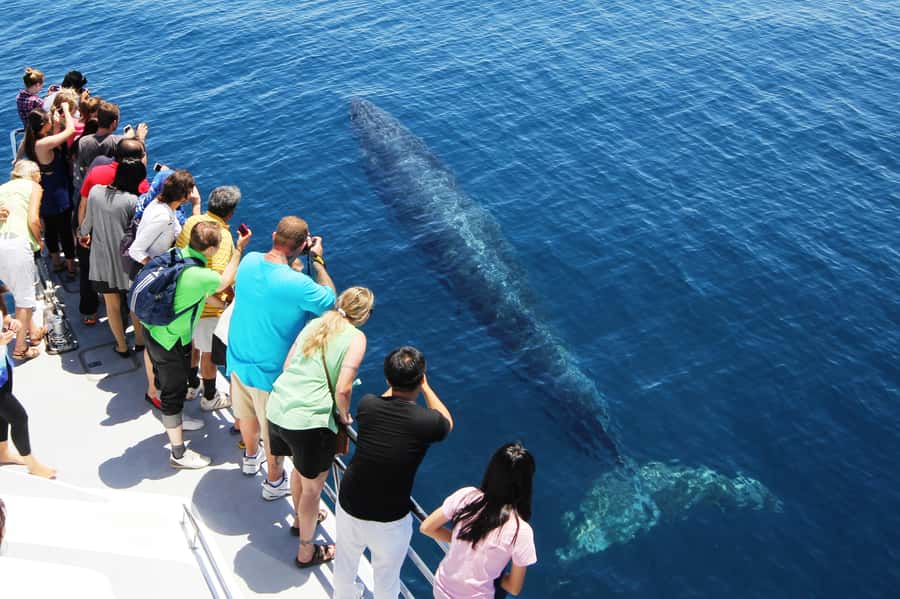
I would choose this outing for anyone who wants a real marine experience without spending a full day away from Auckland. It suits families with supervised young children, couples, photographers, bird watchers, and anyone interested in marine science.
It is also a good pick if you have already done the main city sights and want to see Auckland from a different angle. The combination of Devonport, North Head, Rangitoto, and the gulf gives you a worthwhile sightseeing ride even before an animal appears.
You should think twice if you dislike boats, feel unwell on open water, need guaranteed whale sightings, or have limited mobility. The vessel is not wheelchair accessible, and the possibility of four and a half hours at sea is not a small detail.
I would also avoid placing this cruise on the tightest part of your schedule. The listed duration is 270 minutes, but weather and wildlife can affect timing. Leave breathing room before your next fixed booking.
Booking, cancellations, and the no-sighting policy
You can cancel up to 24 hours before departure for a full refund, and the reserve-now, pay-later option keeps your plans flexible. That is useful in Auckland, where weather can shift quickly.
If the crew finds no marine mammals, you can take the cruise again for free. This does not mean you receive a second trip after missing a whale if dolphins were seen. The policy is aimed at days with no marine mammal sightings, so clarify the exact conditions when checking your voucher.
The provider has shown flexibility when weather warnings arise, offering refunds or rebooking in difficult conditions. That is reassuring, but the final decision always depends on sea and wind conditions.
Should you book the Dolphin Explorer?
Yes, if you accept the uncertainty of wild animals and value the science behind the outing. The strongest reasons are the close dolphin encounters, the comfortable-sized catamaran, the skilled crew, and the chance to see the gulf as a living ecosystem rather than a backdrop.
Book it with realistic expectations. Whales and orcas are possible, not promised. A successful trip may mean dolphins, gannets, penguins, a shark, and a clear view of Rangitoto. On a quiet day, the research commentary and coastal scenery still give the cruise substance.
I would book early in an Auckland stay rather than on your final half-day. That gives you a chance to use the second-cruise option if the first outing is cancelled or produces no mammals. For a well-prepared visitor who wants wildlife in the open sea, this is a worthwhile $130 experience.
FAQ
Where does the Auckland whale and dolphin cruise depart from?
The boat departs from Berth 9 at Eastern Viaduct Marina, at the end of Quay Street heading west. The berth is opposite the Maritime Museum.
How early should I arrive?
You should arrive 30 minutes before departure to check in at the top of the boarding ramp. Check-in closes 15 minutes before the scheduled trip time.
How long does the cruise last?
The eco-cruise lasts 270 minutes, or 4.5 hours.
What animals might I see?
Possible sightings include bottlenose and common dolphins, orcas, whales, gannets, shearwaters, little blue penguins, and sharks. Wildlife sightings are not guaranteed.
Can I take the cruise again if I see no marine mammals?
Yes. If you do not see any marine mammals, you can take the cruise again for free using the voucher provided by the operator.
Is food included?
No. A small range of snacks, hot food, and drinks can be purchased on board. Beer and wine are also available.
What should I bring?
Bring warm clothes, a showerproof jacket, a sun hat, sunscreen, a camera, binoculars if you have them, personal medication, and seasickness medicine if needed.
Is the boat wheelchair accessible?
No. The vessel has stairs and narrow doorways, so it is not wheelchair accessible.
Are young children allowed?
Children under five are allowed only when closely supervised by a parent or guardian. Unaccompanied minors are not allowed.
Can the cruise be cancelled because of weather?
Yes. The provider may cancel a trip because of wind, weather, or sea conditions. If conditions are poor, you may be offered a refund or rebooking option.
More Half-Day in Auckland
- Half-day Discover Auckland City Sightseeing Tour
★ 5.0 · 1,080 reviews - Auckland Scenic Half-Day City Sightseeing Tour
★ 4.8 · 532 reviews - Half-Day: Small Group Auckland Scenic Tour – 4 HOURS
★ 5.0 · 152 reviews - Auckland Shore Excursion: Half-Day Guided City Tour
★ 5.0 · 148 reviews
More Boat Trips from Auckland
- Auckland Harbour Sailboat Cruise Including Three Course Dinner
★ 4.5 · 476 reviews - America’s Cup 2-Hour Sailing Experience Waitemata Harbour
★ 4.8 · 370 reviews - Auckland: Scenic Harbour Sightseeing Cruise
★ 4.5 · 369 reviews - Auckland: Harbour Sailing Cruise with 3-Course Dinner
★ 4.5 · 319 reviews
Recently added around Auckland
- Waiheke Island: Gulf Marine Park Sailing Adventure & Lunch★ 5.0 · 4 reviews
- Waiheke Island: Scenic PREMIUM Wine Tour. Max 11 clients★ 4.9 · 8 reviews
- Flavours of Waiheke, wine, beer, spirits INCLUDES lunch – MAX 11★ 5.0 · 9 reviews
- Waiheke Island: Premium Vineyard, Wine Tasting and Bush Walk★ 5.0 · 4 reviews
- Waiheke Island Private Double Headland Walk★ 5.0 · 5 reviews
- Heke Brewery and Distillery Tour in Waiheke Island with samples★ 4.5 · 3 reviews
- Waiheke Island Private History and Heritage Tour★ 4.5 · 7 reviews
- Waiheke Island Private Art Tour★ 5.0 · 5 reviews
Dolphin Watching, compared.
Auckland Dolphin and Whale Watching Eco-Safari Cruise
Read our review →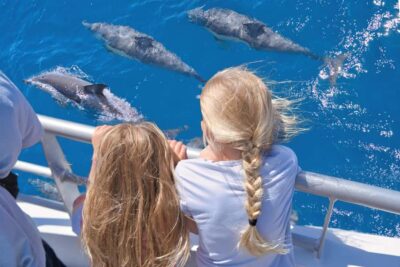
Tikapa Moana Whales, Dolphins and Islands Cruise
Read our review →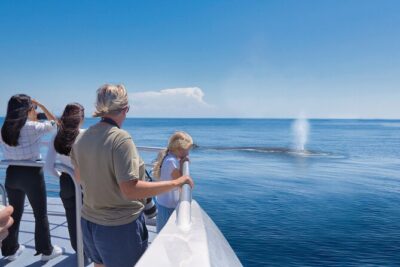
Browse the lists this tour appears in