
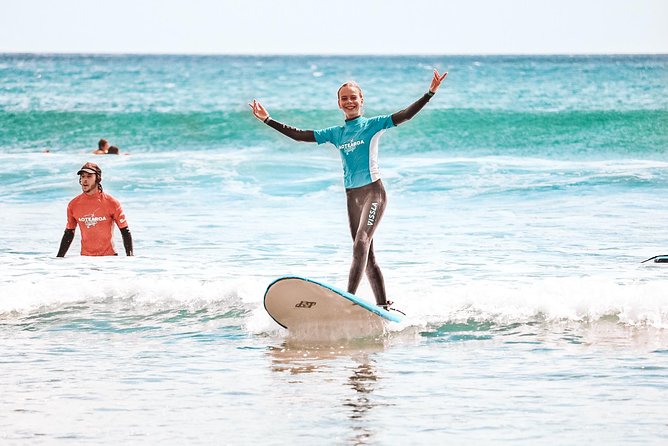
Reviewed · WORKSHOPS
Private 2 Hour Surf Lesson
Te Arai’s sandy beach and generally gentle East Coast surf make this a sensible place to learn. The lesson moves from ocean safety and board skills to the moment you paddle, pop up, and try to ride a wave. Your instructor can slow down for a first-timer or work on technique if you already surf.
I like the private format, since you are not forced to match the pace of a large mixed group. I also like the all-in setup: board, leash, wetsuit, rash shirt, and sunscreen are supplied. The main catch is weather. Surfing needs suitable conditions, and the total outing takes about two and a half hours even though the lesson itself lasts two hours.
Key points at a glance
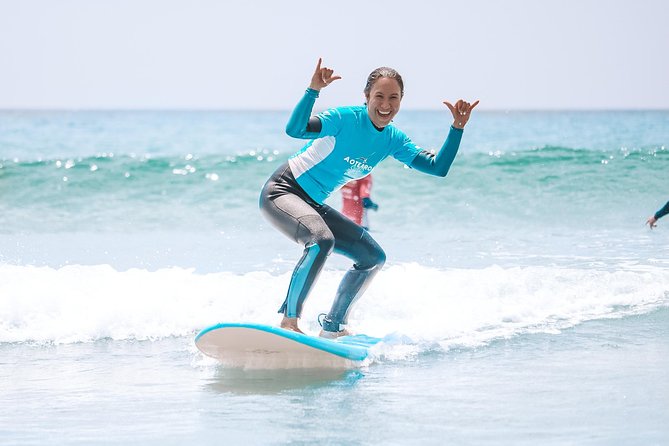
- Te Arai Point setting: Learn on a sandy beach along Auckland’s East Coast, away from an indoor pool or artificial wave machine.
- Private instruction: The lesson is for your group alone, with tuition adjusted to your ability and pace.
- Clear beginner pathway: Safety, equipment, positioning, paddling, pop-ups, timing, and wave riding are all covered.
- Equipment included: You receive a surfboard, leash, wetsuit, rash shirt, and sunscreen.
- Strong family and group appeal: Instructor Lee worked successfully with eight-year-old Sebastien, while Andrew helped two daughters gain enough confidence to want regular lessons.
- Weather matters: Poor conditions can lead to a new date or a full refund, and changes or cancellations must be made at least 24 hours ahead.
Why Te Arai is a useful place to learn
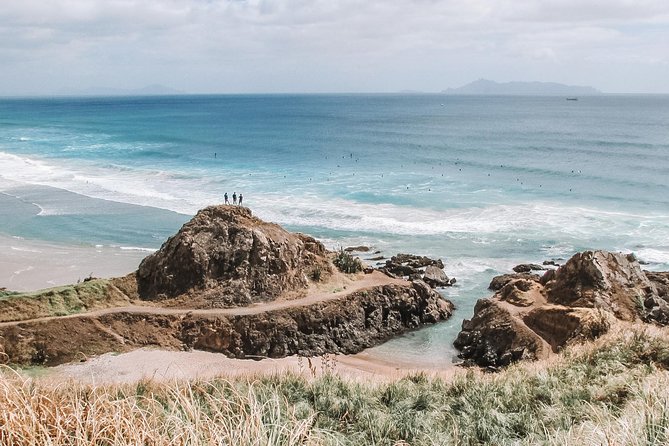
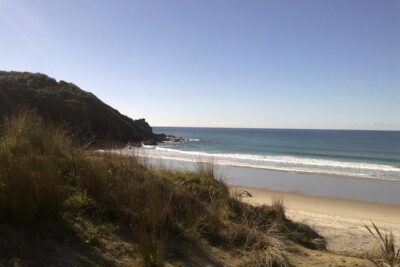
Te Arai is a practical choice for a first surf lesson because the class takes place on a sandy beach with calm, consistent surf described as suitable for beginners. That matters more than postcard scenery. You need room to handle a board, practice standing, and recover from the occasional tumble without worrying about a rocky entry.
The setting also gives the lesson a proper New Zealand beach feel. You are not simply being shown a sequence of exercises on dry land. The sea itself becomes part of the lesson, so you learn to read waves, position your board, and understand when it is sensible to paddle.
Conditions can still change. The beach may be beginner-friendly without producing perfect waves every day. The operator requires good weather, and a weather cancellation brings the choice of another date or a full refund. That policy is useful, but you should keep some flexibility in your Auckland plans.
More surf lessons near Auckland:
- 2 Hour Surf Lesson – Te Arai Beach
★ 5.0 · 119 reviews - Auckland: Group Surfing Lesson with Muriwai Surf School
★ 4.9 · 34 reviews - Beginner Surf Lesson at Te Arai Beach
★ 5.0 · 6 reviews
The first stage: safety, equipment, and position
A good surf lesson starts before you attempt to stand. Your instructor covers safety, the design of the equipment, and the right position on the board. These details may sound basic, but poor positioning wastes energy and makes a beginner’s first waves much harder to catch.
You receive the main equipment as part of the price: a surfboard, leash, wetsuit, rash shirt, and sunscreen. The wetsuit and rash shirt make the session more comfortable and reduce the need to pack specialist gear. The leash is also an important part of learning how to manage the board after a fall.
The equipment section should help you understand how the board sits in the water and where your body needs to be. The supplied information does not specify board sizes or brands, so do not book expecting a particular model. The useful part is that the school provides the required kit and helps you use it properly.
Paddling, ocean awareness, and getting out the back
Once you understand the board, the lesson turns to paddling technique and ocean awareness. You learn how to move with the water rather than simply thrash your arms and hope for speed. That early instruction can save you a great deal of frustration.
Ocean awareness is especially valuable for someone who has never surfed. You need to notice the timing of waves, where to position yourself, and how to manage the board as the water changes. The lesson also includes getting out the back, meaning moving beyond the area where waves break so you can prepare for a ride.
Your instructor can adjust this section to your level. A first-timer may need more time on board control and safety. Someone with some experience may spend less time on basic handling and more time on wave selection, timing, and take-off technique.
The moment that matters: timing and the pop-up
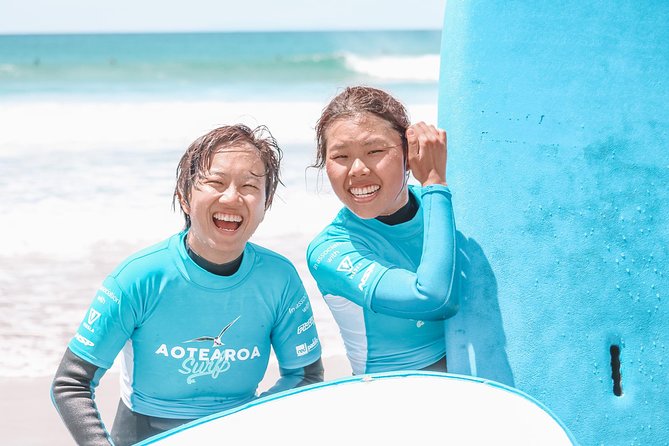
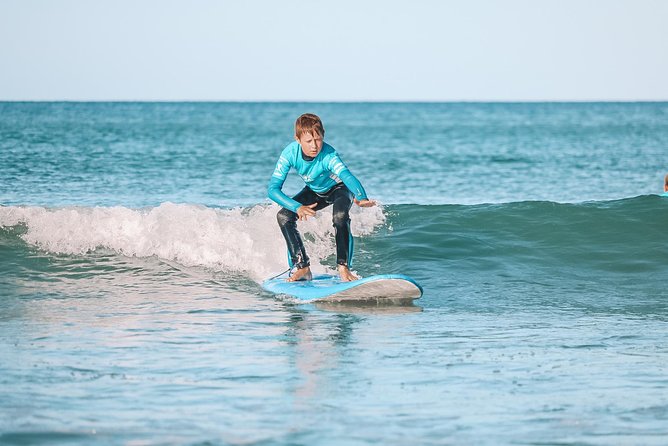
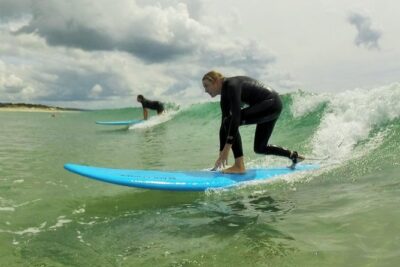
For most beginners, the pop-up is the key challenge. You start lying on the board, paddle into a wave, and then move your feet underneath you quickly enough to stand. The lesson breaks this into parts, including timing, take-off, and mastering the pop-up.
That structure is helpful because standing on a surfboard is not just a matter of strength. You need to start at the right moment, keep your body balanced, and avoid rushing before the wave has enough push. Private tuition lets the instructor watch your movement closely and give immediate corrections.
The supplied feedback includes a particularly useful example. A father with no previous surfing experience was able to stand and ride a wave inshore by the end of his lesson. That does not promise the same result for every person, since surf conditions and fitness vary, but it shows why direct instruction can be worth paying for.
More workshops and classes in Auckland:
- Wētā Workshop Unleashed Tour – Auckland
★ 4.5 · 903 reviews - Auckland: Wētā Workshop Unleashed Guided Tour Ticket
★ 4.6 · 406 reviews - Wētā Workshop Unleashed – Intro to Scars and Scrapes Workshop
★ 5.0 · 5 reviews - Auckland: Perfume Making Class Introduction
★ 5.0 · 3 reviews
Riding waves instead of just standing up
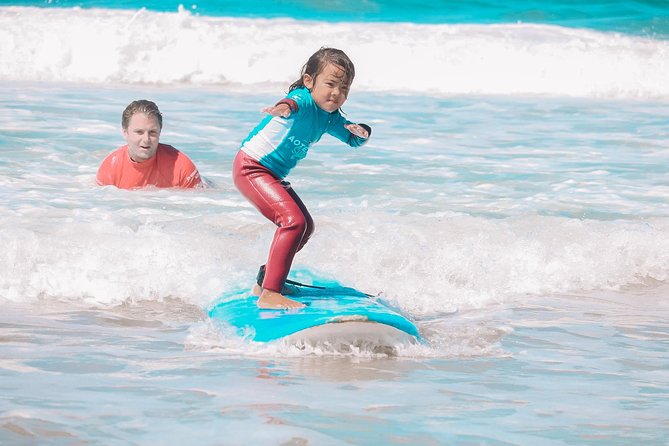
The goal is not simply to pop up once for a photograph. The final part of the lesson focuses on riding waves, helping you connect the earlier skills into one movement: position the board, paddle at the right time, stand with control, and steer your ride toward shore.
You may find that the first successful ride is short. That is normal for a beginner lesson. The value comes from learning what caused the successful attempt and what went wrong on the others. A private instructor can spend more time on your specific problem instead of moving the whole class along.
The school also offers souvenir photos for an extra charge. They are not included, so decide in advance if you care about a record of your first ride. The supplied information does not state the photo price or how many images are provided.
A private lesson for families and mixed abilities
This experience should suit families particularly well. Instructor Lee received specific praise for working with eight-year-old Sebastien, while Andrew taught two daughters who finished eager to continue improving. Those examples suggest that the school can keep younger students involved, but the activity still requires a moderate level of physical fitness.
You should also consider the private format if people in your group have different confidence levels. One person may be standing quickly while another is still working on paddling. A private lesson gives the instructor more room to adjust the pace and explain things in a way that fits the group.
The booking is described as a private activity, with only your group participating. Group discounts are listed as a feature, and a large group booking was adjusted several times as it grew from nine to fourteen people. For a big party, confirm how instruction will be organized before booking, since a private group lesson is not necessarily the same as one instructor giving continuous one-to-one attention to every person.
What the two hours are likely to feel like
The lesson is advertised as two hours, while the overall experience is listed at about two hours and thirty minutes. Allow time beyond the water session for meeting at the school, getting equipped, and wrapping up. The exact division of time is not specified, so do not schedule a tight appointment immediately afterward.
The teaching sequence gives the session a clear shape:
- Safety and ocean awareness
- Equipment design and board positioning
- Paddling and getting beyond the breaking waves
- Timing and take-off
- The pop-up
- Riding waves
This progression is a good sign for beginners because it avoids treating surfing as a single trick. You learn the pieces in the order you need them. The pace can also change if the sea, your fitness, or your confidence calls for more time on one part.
What is included for $126.67
At $126.67 per person, this is not the cheapest way to spend two hours at the beach. It is also more than a basic group lesson because you are paying for a private setup, an experienced instructor, and equipment.
The value improves if you are new to surfing and would otherwise need to rent a board, wetsuit, leash, and rash shirt separately. Sunscreen is included too, which is a small but useful touch for a session on an exposed beach. All taxes, fees, and handling charges are covered in the listed price.
I would judge the cost by the amount of personal attention you need. If you are nervous, have limited time in Auckland, or want a lesson shaped around your own ability, the price is easier to justify. If you are happy learning in a larger class and mainly want to try standing once, a group option may offer better value if available.
The private format is also useful for a family or small group that wants the session to stay together. Group discounts are available, but the exact discount is not provided, so check the final price for your party before confirming.
Meeting at Aotearoa Surf School
The meeting point is Aotearoa Surf School, 708 Te Arai Point Road, Te Arai 0975, New Zealand. The experience ends back at the same meeting point. No transport from Auckland is included in the supplied details, so you should plan your own way to Te Arai.
That location makes this a better fit for a self-driving East Coast day than for someone relying on a short city-centre activity. You should also leave enough time to arrive before the lesson, since the activity begins and ends at the school rather than at a central Auckland pickup point.
The immediate setting is part of the appeal. You get a real beach lesson on Auckland’s East Coast, with the focus on handling waves rather than watching a demonstration from shore.
Fitness, age, and comfort
You need a moderate level of physical fitness. Surfing involves paddling, lifting your body into a standing position, balancing, and repeated attempts. Even a calm beach session can feel tiring, especially if you are not used to swimming or board sports.
The available information does not set a minimum age or list swimming requirements. It does show that an eight-year-old took part successfully, but that should not be treated as a universal age rule. If you are booking for a child, confirm suitability with the school.
Service animals are allowed. The information does not provide further details about how a service animal can remain safely accommodated during the beach and water portions, so ask the operator before booking if this affects your plans.
Weather, changes, and practical planning
You can cancel for a full refund if you do so at least 24 hours before the local start time. A cancellation made less than 24 hours before the start is not refunded, and changes inside that period are not accepted.
The weather rule is more generous when conditions are unsuitable. If the operator cancels because of poor weather, you are offered another date or a full refund. This is important for a surf lesson, since forcing a session in poor conditions would defeat the purpose and could reduce safety.
The supplied comments include a lesson held during stormy weather, with the group still describing it as a very good experience. That should not encourage you to ignore the weather policy. Surf conditions can be enjoyable one day and unsuitable the next, so keep a spare day if surfing is a major part of your Auckland plans.
Who should book this lesson
I would choose this for:
- A complete beginner who wants personal guidance
- A family with a child or mixed confidence levels
- A couple or small group that prefers a private session
- Someone who wants to learn proper technique rather than simply rent a board
- A beginner with limited time who wants equipment and instruction handled together
- A more experienced surfer who wants focused help with timing, take-off, or wave riding
I would think twice if you have very limited mobility, do not feel comfortable with moderate physical activity, or need a guaranteed session at a fixed time. The weather policy and ocean conditions make flexibility important.
Should you book the Te Arai private surf lesson?
Book it if you want a focused introduction to surfing and value one-to-one instruction over the lowest possible price. The private format, complete equipment package, sandy beginner beach, and clear teaching sequence give you a sensible way to start.
The strongest reason to choose it is personal attention. Lee’s work with an eight-year-old and Andrew’s success with two daughters show the kind of family-friendly instruction the school can provide. The father who stood and rode by the end also shows what a well-structured beginner lesson can make possible.
Skip it if you only want a cheap beach activity, need guaranteed weather, or prefer a large social class. For everyone else, Aotearoa Surf School offers a practical, well-supported first step into surfing at Te Arai.
FAQ
Where does the private surf lesson take place?
The lesson starts and ends at Aotearoa Surf School, 708 Te Arai Point Road, Te Arai 0975, New Zealand.
How long does the experience last?
The surf lesson lasts two hours, while the total experience is listed as approximately two hours and thirty minutes.
Is this a private activity?
Yes. Only your group participates in the private activity.
Is the lesson suitable for complete beginners?
Yes. The lesson is designed for complete beginners and covers safety, equipment, positioning, paddling, timing, the pop-up, and riding waves.
What equipment is included?
A surfboard, leash, wetsuit, rash shirt, and sunscreen are included.
Is an instructor included?
Yes. A qualified and experienced instructor leads the lesson.
Can children take part?
The available information does not give a minimum age. An eight-year-old, Sebastien, took part in a lesson with instructor Lee, but you should confirm suitability for your child with the school.
What happens if the weather is poor?
If the experience is canceled because of poor weather, you can choose another date or receive a full refund.
How far in advance can I cancel for a full refund?
You must cancel at least 24 hours before the experience’s local start time for a full refund. Cancellations or changes made less than 24 hours before the start are not accepted for a refund.
Recently added around Auckland
- Waiheke Island: Gulf Marine Park Sailing Adventure & Lunch★ 5.0 · 4 reviews
- Waiheke Island: Scenic PREMIUM Wine Tour. Max 11 clients★ 4.9 · 8 reviews
- Flavours of Waiheke, wine, beer, spirits INCLUDES lunch – MAX 11★ 5.0 · 9 reviews
- Waiheke Island: Premium Vineyard, Wine Tasting and Bush Walk★ 5.0 · 4 reviews
- Waiheke Island Private Double Headland Walk★ 5.0 · 5 reviews
- Heke Brewery and Distillery Tour in Waiheke Island with samples★ 4.5 · 3 reviews
- Waiheke Island Private Art Tour★ 5.0 · 5 reviews
- Waiheke Island Private History and Heritage Tour★ 4.5 · 7 reviews
Workshops, compared.


Wētā Workshop Unleashed – Intro to Scars and Scrapes Workshop
Read our review →
Browse the lists this tour appears in